• Meet Dr. Robotti
  • Papers
  • Gallery
  • Focus Rhinoplasty
  • Academy
Menu
Contacts
  • EN
    • IT
    • EN
Primary

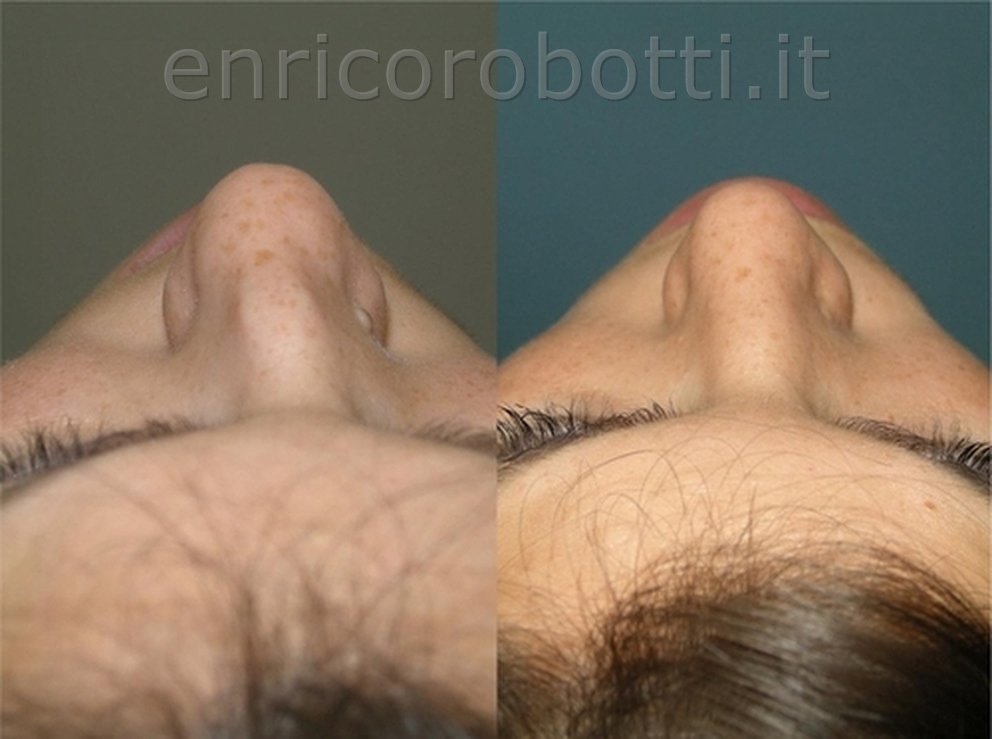
In this patient, the deviation to the left and the bulbous tip are evident, in addition to a modest dorsal hump. Through the particularly thin skin, one can see, on the left side, the junctional area between the nasal bone and the upper lateral cartilage. This transition zone (the “keystone”) is extremely delicate and important: in fact, this is precisely the level at which irregularities may occur—especially in thin-skinned patients—after lowering the hump and performing the surgical fractures (osteotomies) of the nasal bones. In this case, some irregularities are already visible preoperatively due to the deviation itself. The patient desires a natural appearance, but with a slight concavity (which may be desirable in a young woman) and with a tip that is more defined relative to the dorsum. Computer simulation is very important for this purpose.

The aesthetic lines of the dorsum have become harmonious, gently diverging from top to bottom. The deviation has been corrected almost entirely, and the keystone area has been softened.
The distal deviation of the septum at the columella has been corrected, improving respiratory function, particularly on the left, where the nostril had been nearly obstructed. The scar is barely visible.
In the three-quarter view, proportions have improved, and the tip is now clearly defined relative to the dorsum.
In the profile view, the dorsal hump has been lowered. The profile now appears slightly concave and just a bit lower than the line connecting the root to the point of maximal tip projection.
Menu
  • Home
  • Meet Dr. Robotti
  • Papers
  • Gallery
© 2026 Enrico Robotti
P.IVA 03955080167

Privacy Policy
Cookie Policy

Design by Elidria
  • Home
  • Meet Dr. Robotti
  • Papers
  • Gallery
  • Focus Rhinoplasty
  • Robotti Rhinoplasty Academy
Contacts
xgriparrow-right4chevron-down5instagram3