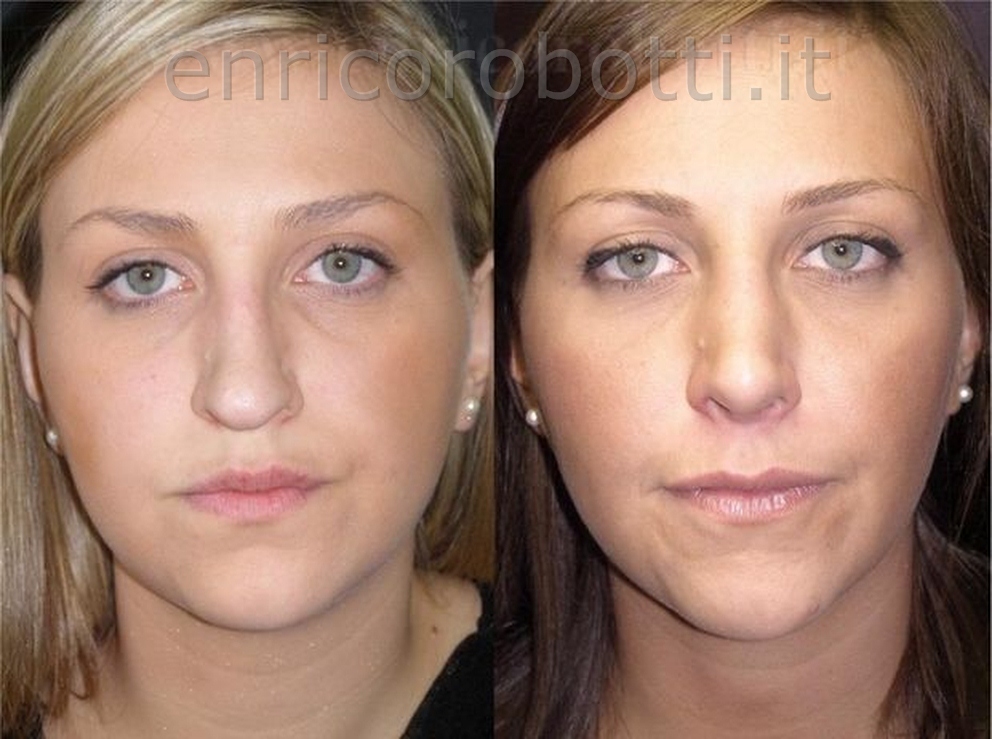
In this young woman, who previously underwent closed rhinoplasty, there is clear irregularity of the dorsal aesthetic lines and, above all, deformity of the tip cartilages, which have been left excessively long and overprojected. As is often seen in secondary rhinoplasty, the nasal septum has been inappropriately resected at its base, causing collapse of the now-unsupported tip and making the nasolabial angle excessively acute. Here again, the goal will be to restore correct proportions by reducing the structures that were not adequately treated (the tip cartilages) and reintegrating, with grafts, the components that were excessively removed (the distal portion of the septum). The alar cartilages will be shortened by “telescoping” them onto themselves and supporting them with thin grafts. The graft that will restore the distal part of the septum, and thus support the tip, will be harvested from the highest portion of the septum itself, simultaneously correcting the residual septal deviation. Temporalis fascia was used as camouflage over the dorsum in order to minimize irregularities at the junction between the nasal bones and the upper lateral (“triangular”) cartilages.