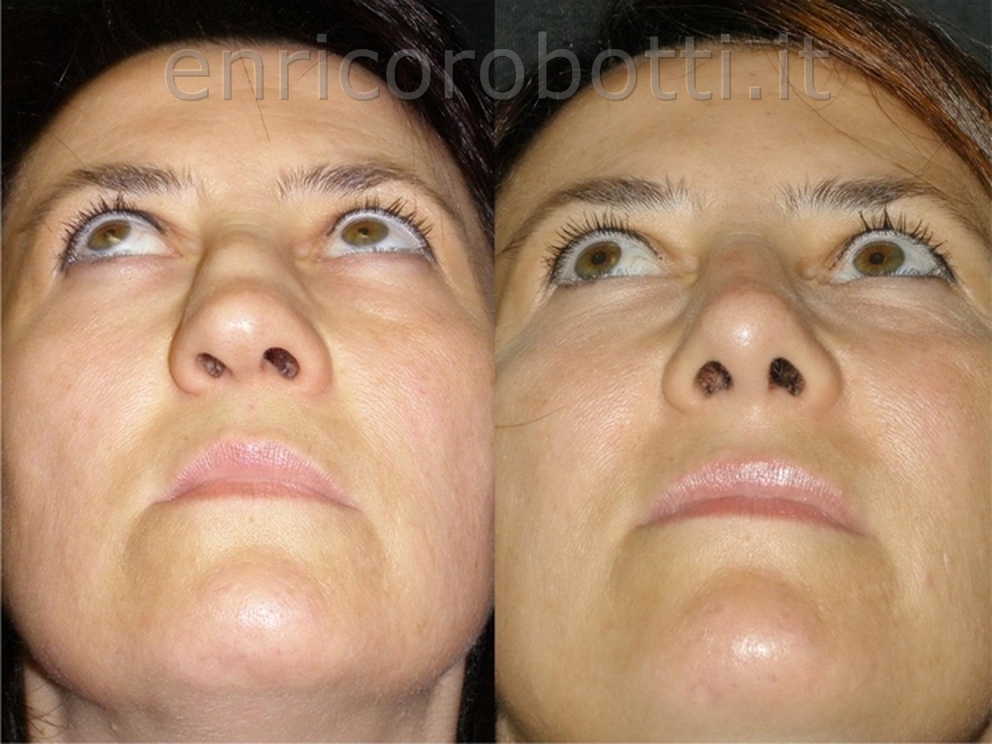
This patient sustained nasal trauma in childhood. She subsequently underwent rhinoseptoplasty without satisfactory results. The evident problem is the marked deviation and the persistent difficulty in nasal breathing. The deformity is present both in the frontal view and in the two three-quarter views. In profile, the dorsal hump is obvious, predominantly bony, partly real and partly apparent, that is also due to collapse of the septum, with a depression (saddle deformity) just before the tip. The tip also appears rather bulbous. Correction of the deviation must be carried out by analyzing and releasing each component of the nose that contributes to the deviation. In other words, the nasal bones must be completely mobilized with several appropriate osteotomies, and the residual septum and cartilaginous components of the dorsum and tip must be freed from their interconnections. Once this has been done, a solid and permanent framework must be reestablished with the help of multiple stabilizing grafts. Obviously, the open approach is essential to perform all these maneuvers precisely, under direct vision. It will not always be possible to achieve 100% correction of the deviation, but in any case a very substantial improvement compared with the baseline situation will be obtained.